


You’ve probably been told that confidence is something you either have or you don’t. That some people are just built that way.
That’s Bullshit. And it’s costing YOU a lot, because it gives you permission to wait.
= missed opportunities
= wasted time
= financial waste
Here’s what’s actually true: confidence behaves like every other skill. It’s clumsy at first, it improves with practice, and it is built entirely by doing the thing before you feel ready to do it.
Nobody felt confident on a bike before they got on one. You wobbled. You fell off. You put your feet down. And then one day you didn’t, and you never had to think about it again. It became Muscle Memory.
What follows is five things that build that skill, the same five I use with in the 6 week confidence reset & the 21 day confidence boost. None of them require you to become a different person. None of them start with a five-year plan. Most of them below you can RIGHT AWAY. Today.
Read it in one go, it’ll take about fifteen minutes. Then do No. 2 before you close this tab.
1. Stop waiting to feel confident
Almost everyone has the order backwards.
They think it goes: feel confident → do the scary thing.
It actually goes: do the scary thing → survive it → feel confident.
This matters more than it sounds, because if you’ve got the order wrong you will wait forever. You’ll keep checking in with yourself — do I feel ready yet? — and the answer will keep being no, because readiness isn’t a feeling that arrives on its own. It’s something deposited in your account after you’ve done something.
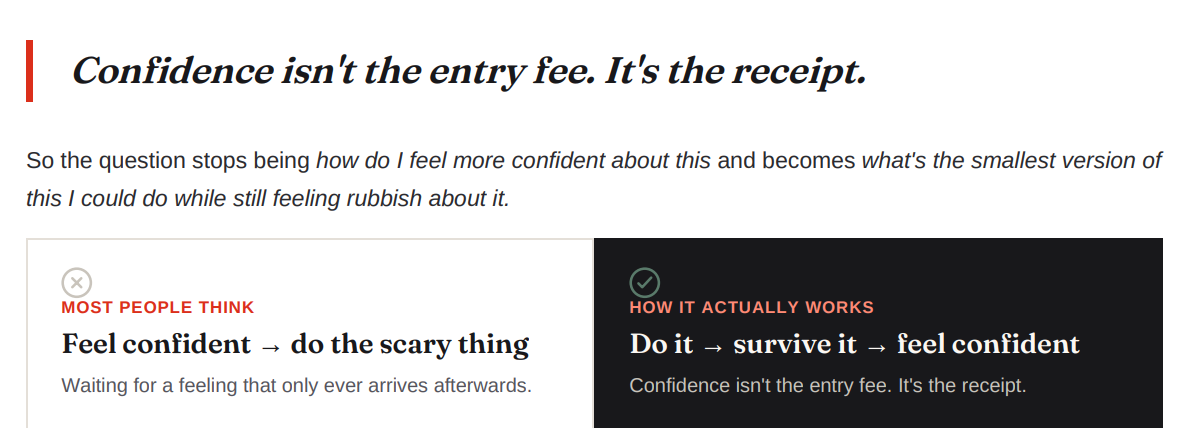
So the question stops being how do I feel more confident about this and becomes what’s the smallest version of this I could do while still feeling rubbish about it.
Do this today: Finish this sentence — “I’ll do it once I feel more…” Whatever you wrote, that’s the thing that is never going to turn up first. Now cross out “once I feel more” and write “badly, on Thursday.”
2. Name the beliefs running things
If thoughts are the weather, beliefs are the climate. A thought shows up on Tuesday and clears by Thursday. A belief has been sitting underneath every decision you’ve made for fifteen years, quietly deciding what’s available to you — and it doesn’t feel like a belief at all. It feels like a personality trait.
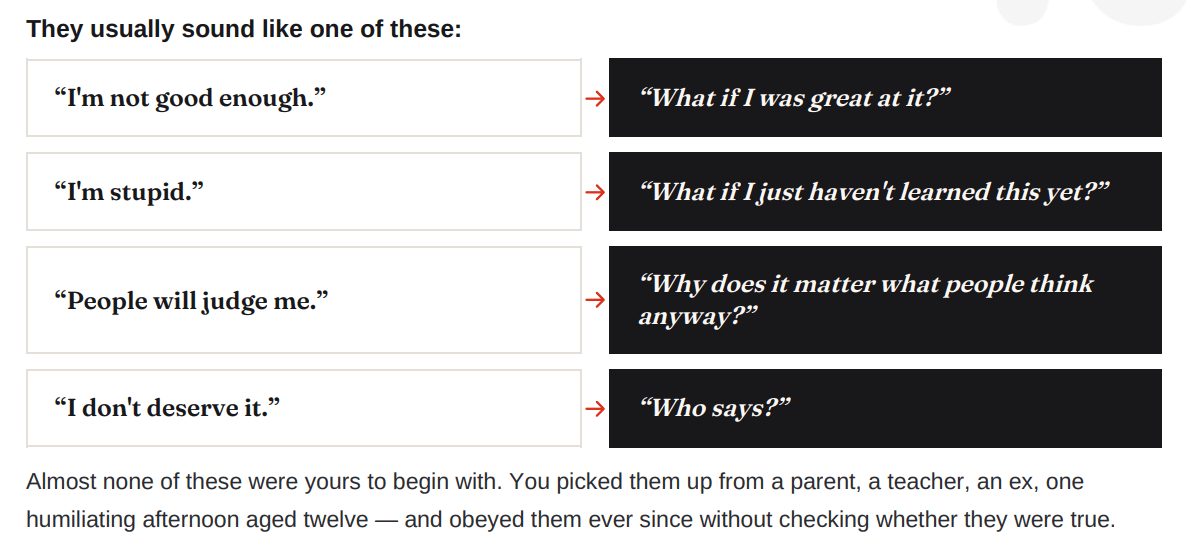
Almost none of these were yours to begin with. You picked them up from a parent, a teacher, an ex, one humiliating afternoon aged twelve — and obeyed them ever since without checking whether they were true.
For each one, ask three questions. Where did I get this? Usually one person, one moment, long ago. Is it still true — was it ever? Say it out loud; most wilt immediately. What would I do next month if it weren’t the case?
Do this today: Pick whichever belief above stings most — that’s the one running the show. Sit with its reframe question for a minute. Then write the flip: “Actually, I’m someone who is learning to…”. Try the exercise live here.
3. Use the “So what?” ladder
This is the one. If you only do one thing from this post, do this one and do it today.
Most fear is vague, and vague fear is unbeatable, because there’s nothing to actually look at. You beat it by making it specific enough to be boring — by asking “so what?” until you run out of road.
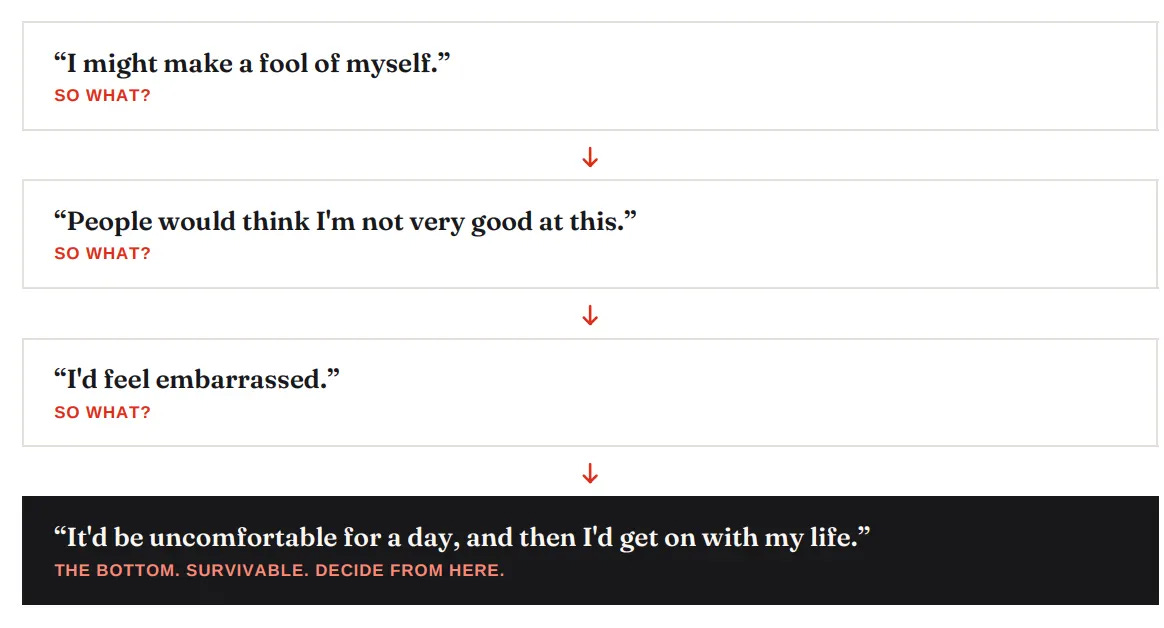
That’s the bottom of the ladder. And nearly every time, it’s something you’ve already survived dozens of times and would survive again by Thursday.
The fear was never really about the outcome. It was about not having looked at the outcome.
4. Work out what your comfort zone is costing you
Your comfort zone doesn’t feel like a cage. That’s the problem with it. It feels like a sofa. It’s warm, it’s familiar, nothing bad happens in there. And because nothing bad happens, it never occurs to you to add up what it’s charging you for the privilege.
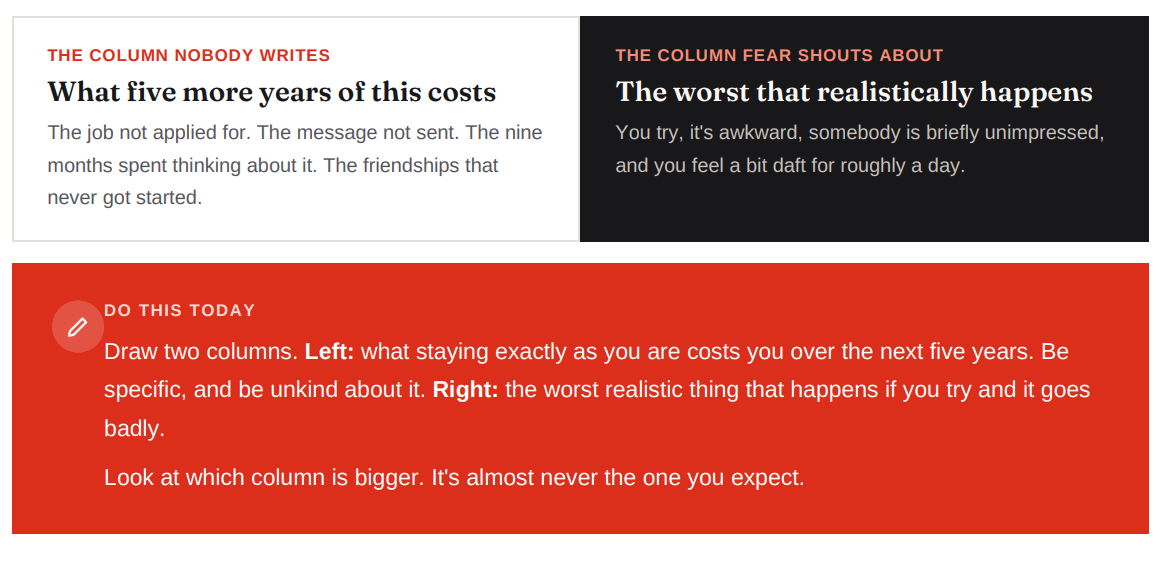
So add it up. Properly, on paper.
Every comfort zone has a price, and the price is always paid in things that didn’t happen. The job you didn’t apply for. The message you didn’t send. The nine months you spent thinking about it. The version of your social life you’d have if you’d said yes to three things last year.
Nobody sends you an invoice for any of that. It just quietly happens, and you find out about it in five years’ time. Try the two lives exercise here and see how different your life could look if you did things a little differently.
This works because fear is very good at making the scary thing feel expensive, and very bad at making not doing it feel like anything at all. Writing the cost down puts both options on the same page, where you can actually compare them.
5. Keep an Evidence Log
Last one — and the one that makes everything above permanent.
The reason you don’t believe you’re capable is that you’re running on out-of-date evidence. Your brain keeps a file on you, and most of it was written when you were fourteen. Every time something goes badly, it’s filed immediately. Every time something goes well, it gets waved off — lucky, fluke, anyone could have done that.
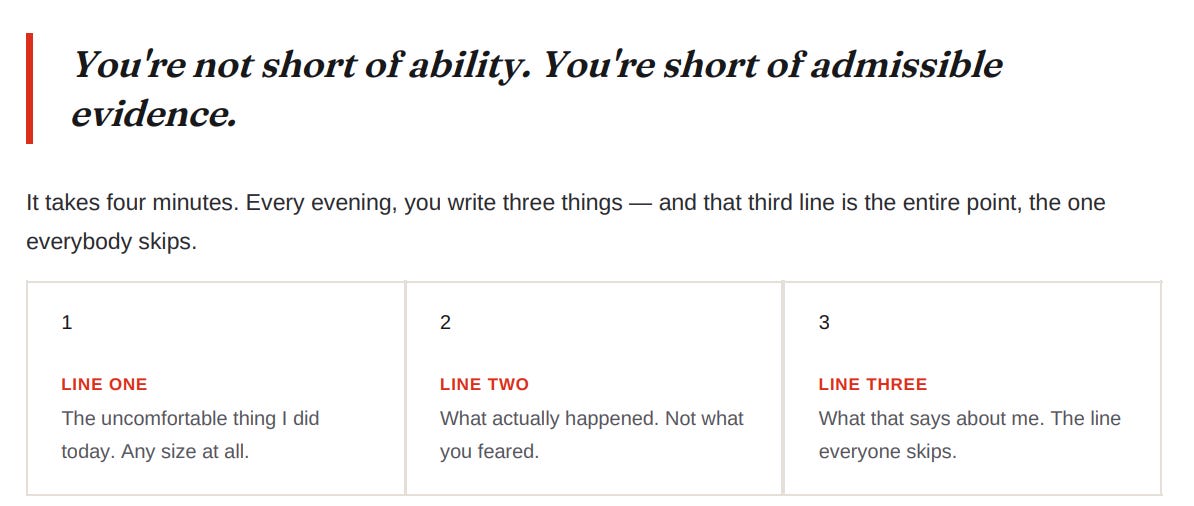
It takes four minutes. Every evening, you write three things — and that third line is the entire point, the one everybody skips:
The uncomfortable thing I did today. Any size at all.
What actually happened. Not what you feared — what occurred.
What that says about me. The line everyone skips, and the whole point.
Do this for two weeks and something strange happens: you stop having to convince yourself you can handle things, because you have a written record saying you already have.
Do this today: Tonight, before bed. Three lines. The notes app on your phone is completely fine. Set a 9pm reminder so it doesn’t depend on you remembering.
Two rules: nothing is too small to count — sending one email counts. And you don’t get to write “nothing” on line one. If the day was genuinely empty, the entry is “I didn’t do anything uncomfortable today, and that’s information too.”
If five feels like a lot, here’s the one-a-day version
Name the three beliefs that are actually running things.
Write down what your comfort zone is costing you.
You don’t have to do this on your own
Everything above works and you can download the actual PDF of this here so you always have it. It works better with someone alongside you — which isn’t a sales line, it’s the finding of every study on behaviour change ever run, and the reason people hire coaches for things they already intellectually understand.
If you want that, here’s what exists:
Come to something free. We run Coffee Clubs and Co-Working every week. No ticket, no membership, come on your own — about nine in ten people do exactly that on their first visit.
Join The 21-Day Confidence Boost. A small group, three live sessions, three Confidence Reps that take you outside your comfort zone. The waitlist for the next cohort is open now.
Or go properly at it. The 1:1 confidence programme is six weeks, one to one, built entirely around whatever your version of “the thing I keep not doing” is. It starts with a free discovery call, and there’s no pitch at the end of it.
Whatever you do next: don’t wait until you feel ready. You’ll be waiting a while.
And actually — do me one favour. Hit reply, comment, and tell me what resonated most with you.
— Jessica